
Christian County Court Records After Arrest
After an arrest in Christian County, the first record is usually a jail booking record. The court record starts when the State's Attorney files or pursues charges and the Circuit Clerk maintains the case. The Christian County Circuit Clerk identifies Jeffrey A. Voorhees as Circuit Clerk and says the office establishes, maintains, and keeps all court records and the official court seal.
The custody side and court side should stay separate. Use jail inmate records for current custody, booking, jail contact, and release-status questions. Use jail mugshots for booking-photo request rules. Court records after a jail arrest focus on the filed charge, the case number, hearings, charge status, bond or release orders, warrants, and disposition.
The Circuit Clerk page links Christian County case information to Judici. The court search image below comes from the Judici Christian County case-search endpoint.
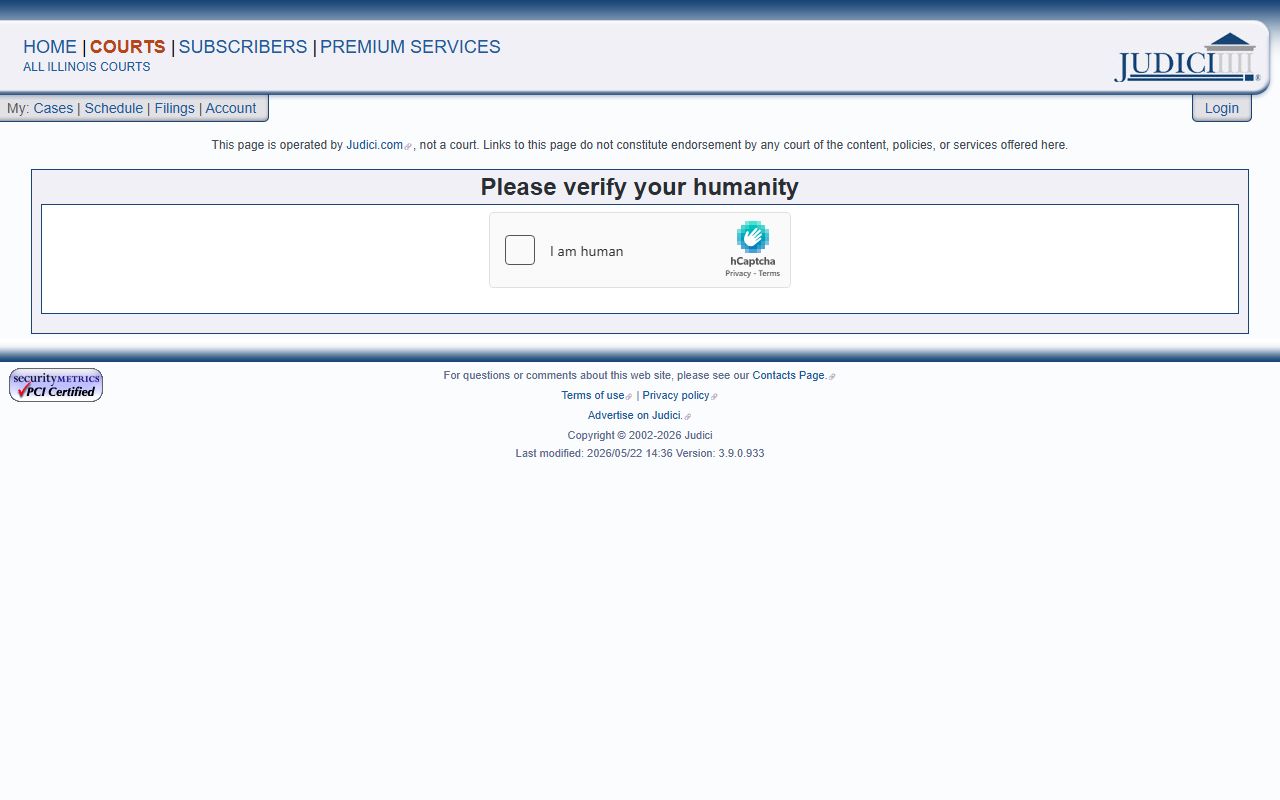
Judici may require human verification before search fields load, so a failed automated query does not mean no Christian County court record exists.
Find Court Records After Arrest
Christian County links case search to Judici from county and Circuit Clerk pages. Use Judici for public case information when available. If Judici blocks access behind a human verification page, if the case is sealed or unavailable, or if exact search fields are unclear, contact the Circuit Clerk by phone at (217) 824-4966 or visit the courthouse at 101 S. Main Street in Taylorville.
- Open the county's Judici case-search link for Christian County.
- Complete any human verification that Judici requires.
- Search by defendant name or case number if available.
- Open the case and read the charge list, filing dates, hearing dates, and disposition fields.
- Call or visit the Circuit Clerk if the case is not public online, is older, or appears sealed, impounded, or protected.
| Search Item | Type | Notes |
|---|---|---|
| Court | Judici page context | Christian County endpoint uses court=IL011015J. |
| Human verification | Security check | Automated inspection reached a verification page. |
| Case number | Search path | Use when known from summons, notice, docket, or clerk contact. |
| Party name | Search path | Use legal spelling and variants. |
Christian County Charges After Arrest
Illinois counties use State's Attorneys, not District Attorneys. The Christian County State's Attorney page identifies John McWard as State's Attorney. The office is described as the chief law enforcement officer for the county and prosecutes criminal actions in the name of the People of Illinois. Its duties include felony and misdemeanor prosecution, Illinois Vehicle Code prosecutions, grand jury work, extradition actions, juvenile matters, and other court-related functions.
That is why booking charges can differ from formal court charges. A jail booking may reflect what an arresting agency initially alleged. The prosecutor then decides whether to file a complaint, information, or seek an indictment. The Circuit Clerk keeps the resulting case record. Charge amendments, reductions, dismissals, and final dispositions are court-record events.
The State's Attorney source page identifies the office and its charge-filing role.
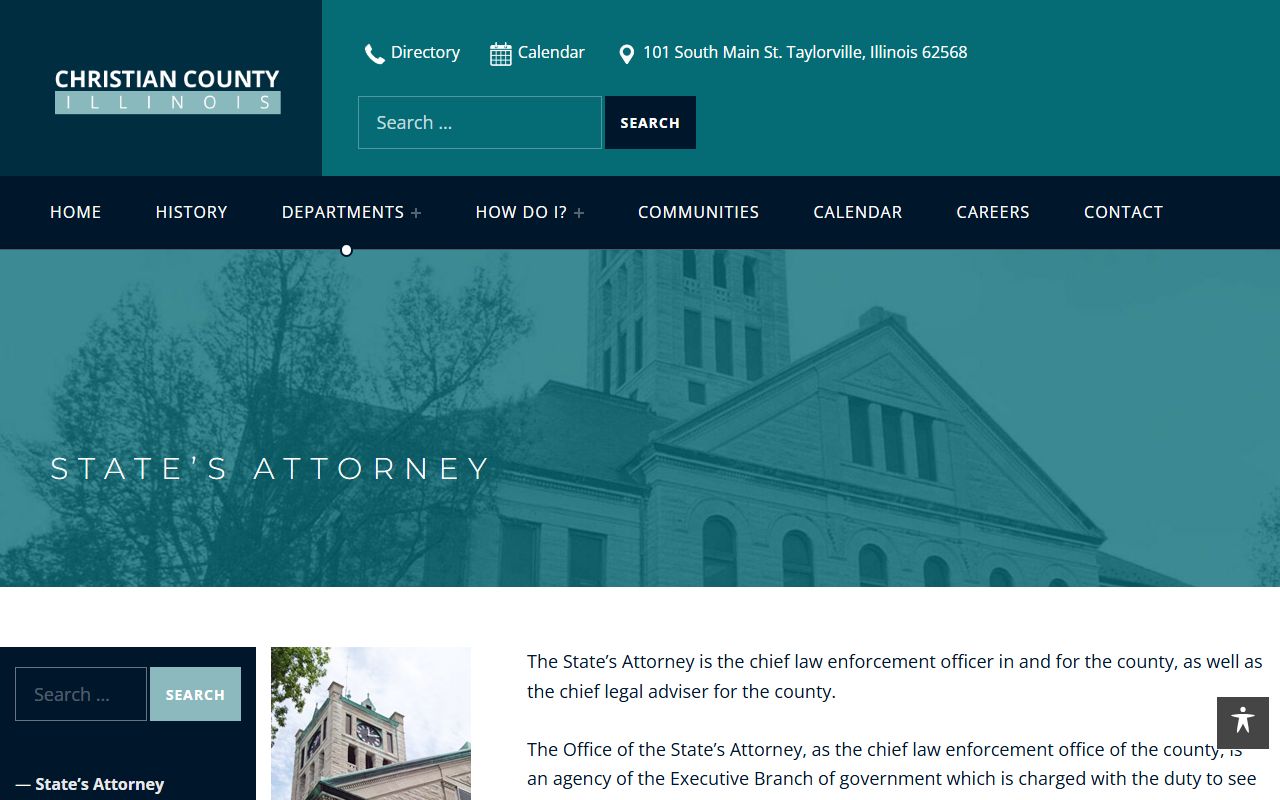
That prosecutor source supports reading court records after arrest as the filed-charge record, not just the jail booking entry.
Charging Documents After Arrest
The State's Attorney page says criminal actions may begin by Information or Complaint in felony or misdemeanor matters, or by asking a Grand Jury to return an Indictment. Each document moves the arrest from a jail event into a court case. The document type affects how the charge appears in the court file, but all three are court-record pathways.
| Document | Who Uses It | What It Does |
|---|---|---|
| Complaint | Prosecutor or law-enforcement supported filing | Begins a criminal case by stating the alleged offense. |
| Information | State's Attorney | Prosecutor-filed charge document used in felony or misdemeanor matters. |
| Indictment | Grand Jury at prosecutor request | Grand Jury charge document, often used for more serious felony matters. |
Christian County Charge Status
A charge listed after an arrest is not fixed forever. It may be pending, amended, reduced, dismissed, or resolved by plea, trial, diversion, or other disposition. A jail status check may answer whether a person is still held, but the court record is the source for filed charge status and future hearing dates.
| Status | What It Means |
|---|---|
| Pending | The charge remains active and the case has not reached final disposition. |
| Amended or reduced | The prosecutor or court changed the charge wording, level, or count. |
| Dismissed | The charge was ended by court order or prosecution action. |
| Nolle prosequi | The prosecutor declined to proceed on that charge. |
| Conviction or disposition | The case resolved by plea, verdict, sentence, dismissal, or another final event. |
Release Orders After Arrest
Illinois changed pretrial release practice after the Pretrial Fairness Act took effect statewide in September 2023. Do not read a modern Christian County court record as if the old cash-bail model still controls ordinary release. The local practical question is whether the court has ordered release with conditions or detention, and whether another hold prevents release.
| Term | Current Meaning |
|---|---|
| Cash bond | Historic term; Illinois no longer uses cash bail as the standard pretrial release condition. |
| Pretrial release | Release under court-set conditions while the case is pending. |
| Detention order | Court order holding a person pretrial after required findings. |
| Hold or detainer | Another agency or case, such as DOC, USMS, another county, or immigration, affects release. |
For local status, call Christian County Jail at (217) 824-4961. For court orders and hearing dates, use Judici or call the Circuit Clerk at (217) 824-4966 during posted office hours.
Christian County Courthouse Records
The Illinois Courts directory lists Christian County Courthouse at 101 S. Main Street in Taylorville, in the Fourth Judicial Circuit and District 5. The directory lists courthouse hours as 8:00 a.m.-4:00 p.m., free parking around the courthouse, two e-filing kiosks in the hallway, a first-floor law library, vending machines, accessibility resources, and a court disability coordinator contact through Jeffrey Voorhees.
Christian County Circuit Clerk
101 S. Main Street
P.O. Box 617
Taylorville, IL 62568
(217) 824-4966
Monday-Friday, 8:00 a.m.-4:00 p.m.
Christian County State's Attorney
101 S. Main Street
Courthouse 3rd Floor
Taylorville, IL 62568
(217) 824-4747
Prosecutor and charge-filing office
The Illinois Courts Christian County Courthouse directory is a useful source for courthouse access details.
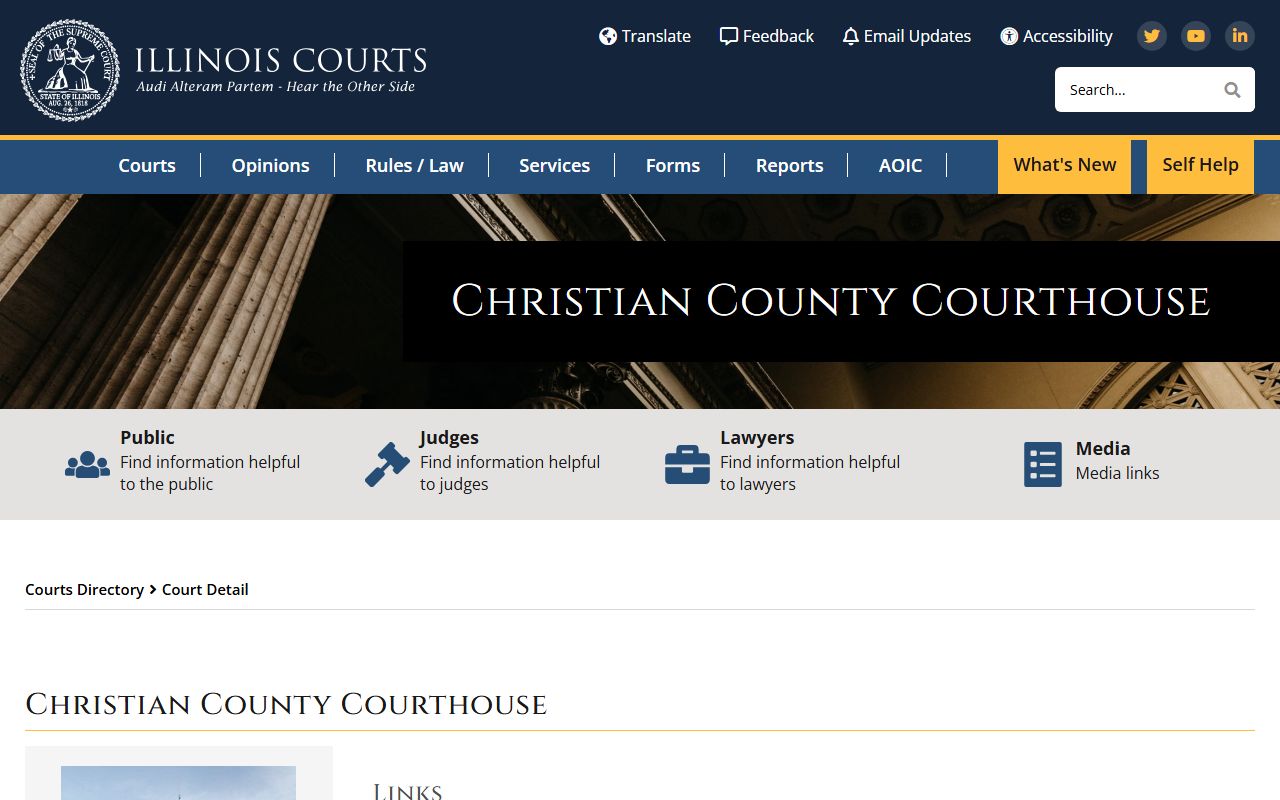
Courthouse details help separate case-record access at 101 S. Main Street from jail custody questions at 301 W. Franklin Street.
Warrants and Jail Arrest Records
No official Christian County Sheriff active-warrant search portal was found during research. A warrant can still lead to a jail arrest. Common warrant types include arrest warrants, bench warrants after failure to appear, out-of-county or fugitive holds, and federal warrants. The jail can answer whether a person is in custody, while the Circuit Clerk and court record can show public case activity when available.
For warrant-related local records, use the sheriff non-emergency line at (217) 824-4961, Circuit Clerk at (217) 824-4966, Court Security Desk at (217) 824-4674, or State's Attorney at (217) 824-4747 depending on the issue. Do not rely on commercial warrant-search pages for Christian County court records after arrest.
Charges Versus Convictions
Being arrested and charged is not the same as being convicted. Court records after a jail arrest may show allegations, pending charges, dismissed charges, or final convictions. A background review that treats all charges as convictions can be wrong and harmful.
| Charge | Conviction | |
|---|---|---|
| Stage | Accusation filed in court. | Final result after plea, verdict, or qualifying disposition. |
| Proof | Allegation supported enough to proceed. | Resolved under criminal procedure and proof standards. |
| Record Meaning | May later be changed, reduced, dismissed, or sealed. | May carry sentence, supervision, fine, or other court result. |
Sealed and Expunged Records
Illinois expungement and sealing rules are found in 20 ILCS 2630/5.2. Expungement can remove or obliterate eligible arrest records. Sealing limits public access while preserving records for authorized uses. Eligibility depends on the charge, disposition, waiting period, prior record, and court order. Juvenile, mental-health, impounded, sealed, and privacy-protected matters may not appear in public search results.
| Sealed | Expunged | |
|---|---|---|
| Public visibility | Hidden from ordinary public access. | Removed or treated as not publicly existing. |
| Record holders | May still retain limited authorized access. | Must follow the court's expungement order. |
| Best route | File through the court process if eligible. | File through the court process if eligible. |
Restricted Court Records After Arrest
Not every court record after a jail arrest is public. Juvenile records, sealed cases, impounded matters, protected victim information, mental-health records, and active investigations can be unavailable or redacted. FOIA also allows exemptions, and other laws can override general public access. When Judici does not show a case, contact the Circuit Clerk rather than assuming the arrest never reached court.
Important: This resource is not a consumer reporting agency and must not be used for FCRA-covered screening.